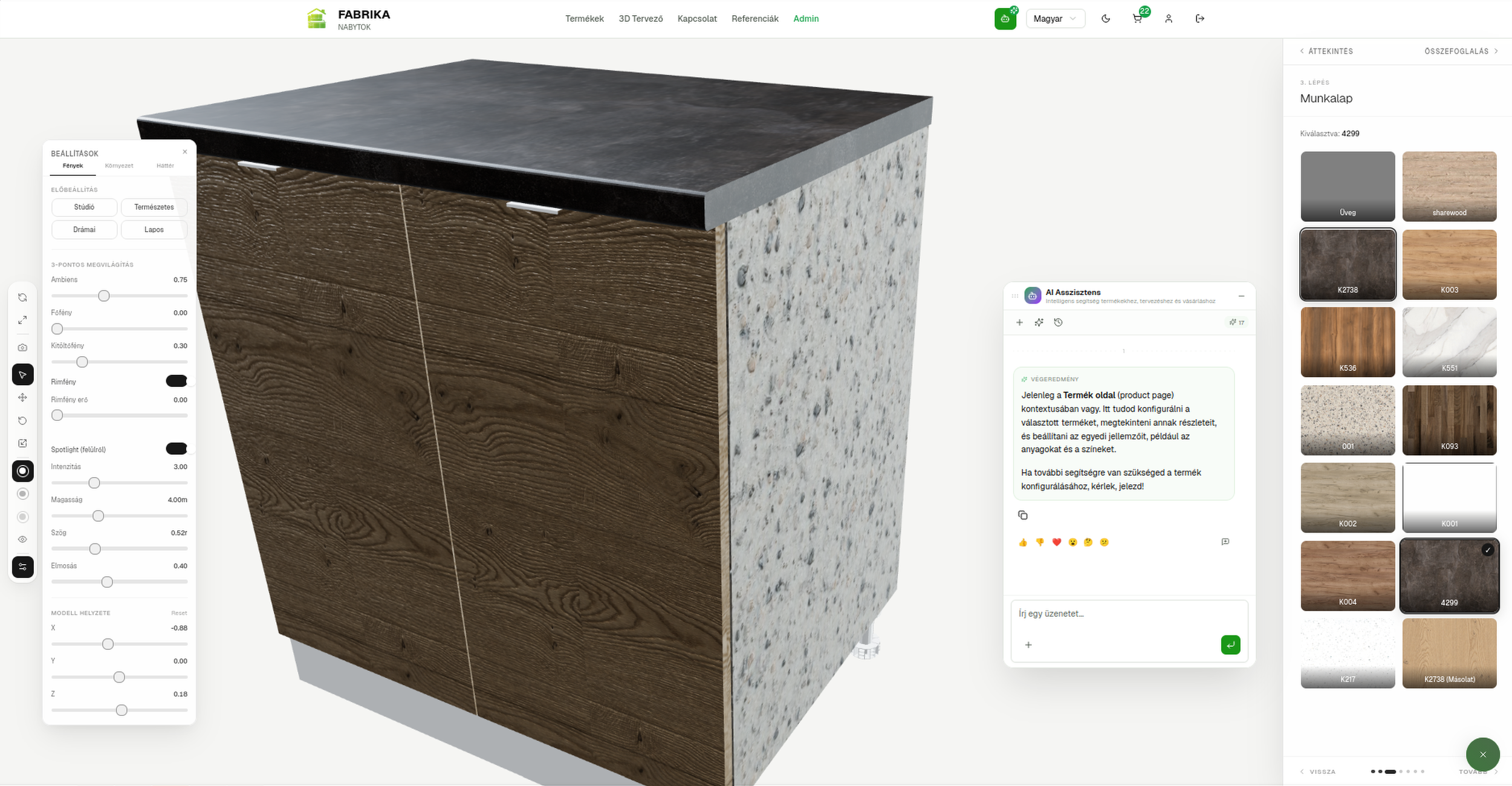
An interactive AI-enhanced 3D kitchen design platform transforming furniture configuration, spatial planning and visualization into a browser-based, photorealistic design experience.
The challenge
Fabrika Nabytok needed a modern digital environment capable of transforming conventional furniture and kitchen planning into an interactive 3D configuration workflow. The system needed to allow users to construct complete kitchen environments from individual furniture modules and objects while maintaining realistic dimensions, spatial relationships, placement rules and physical behaviour.
The challenge was to combine parametric furniture configuration, drag-and-drop spatial composition, photorealistic 3D rendering, accurate 2D planning, realistic physics and intelligent assistance into a single coherent browser-based experience. The platform also needed to support different object types and
Fabrika Nabytok is an advanced browser-based 3D furniture and kitchen design environment created to connect product configuration, spatial planning and intelligent design assistance in one unified workflow. The platform enables users to construct kitchens interactively by selecting, dragging, dropping, positioning and configuring furniture modules and complementary objects inside a realistic virtual environment. Every configurable element can be represented as a structured parametric object with dimensions, materials, components, placement constraints and product-specific configuration parameters. The core design experience combines an ultra-realistic 3D view with a precise 2D planning representation. Users can switch between spatial visualization and technical planning while maintaining a synchronized underlying scene model. Furniture can be moved, rotated, repositioned and configured directly within the environment, with placement logic adapting to the physical and semantic type of each object. Floor furniture interacts with the floor plane, wall-mounted elements respect wall relationships, and other objects can be constrained according to their intended installation context. A physics-aware placement system provides realistic spatial behaviour instead of treating every object as an unrestricted visual mesh. Collision detection, bounding volumes, rigid-body relationships, surface constraints, snapping, alignment and placement validation can be used to prevent intersections, floating objects, penetration into walls or floors and other physically implausible configurations. The result is a design environment where objects behave according to their semantic role within the kitchen rather than simply being positioned in arbitrary 3D coordinates. The parametric configuration layer allows individual furniture elements to be customized without rebuilding their geometry manually. Dimensions, cabinet configurations, doors, drawers, handles, worktops, materials, colors and other product properties can be represented through structured configuration data. The same underlying product definition can therefore generate multiple valid configurations while maintaining consistent geometry, metadata and pricing-related information. The AI layer extends the platform from a conventional 3D editor into an intelligent design assistant. Users can describe their requirements in natural language, such as the desired kitchen style, room characteristics, available dimensions, storage requirements, preferred materials or functional constraints. The AI can interpret these requirements and translate them into structured design operations, recommendations or configuration proposals. It can assist with selecting furniture modules, arranging elements, identifying conflicts, explaining configuration choices and iteratively refining a design based on user feedback. Rather than operating as an isolated chatbot, the AI layer is connected to the platform's design engine and acts as an intelligent orchestration layer over available design operations. This allows natural-language requests to become actionable interactions with the 3D environment, such as adding a cabinet, changing a material, adjusting dimensions, reorganizing a kitchen layout or proposing alternative configurations. The platform is designed around a reusable scene and product model so that the same architecture can support kitchens, individual furniture products and potentially larger interior-design scenarios. Product assets can contain structured metadata describing dimensions, anchor points, sockets, compatible components, placement rules, materials and configuration dependencies. This creates a foundation for a scalable digital product catalogue and future automated configuration and quotation workflows. The rendering layer is built around WebGL and Three.js technologies, enabling interactive real-time visualization directly in the browser. React Three Fiber can provide the component-oriented rendering architecture while Drei and related utilities support cameras, controls, lighting, environment effects and advanced scene interactions. Adaptive rendering and performance strategies can be applied to maintain responsive interaction while displaying increasingly complex kitchen scenes. The system can provide multiple visualization modes including realistic perspective rendering, orthographic technical views, top-down planning, object selection, measurement and scene navigation. The synchronized 2D/3D representation allows users to understand both the aesthetic appearance and the practical spatial organization of the resulting kitchen. From a technical perspective, the platform is structured as a modular application in which the user interface, scene engine, product catalogue, parametric configuration engine, physics layer and AI orchestration layer can evolve independently while communicating through defined data models and service boundaries. Next.js provides the web application foundation, React and TypeScript provide the interactive application layer, Three.js and React Three Fiber provide the 3D environment, and a physics engine such as Rapier can provide collision and rigid-body simulation capabilities. The architecture also creates a foundation for future commercial functionality including automated product pricing, material and component availability, configuration validation, quotation generation, saved projects, user accounts, project sharing, PDF exports, manufacturing data generation, ERP integration, analytics and AI-assisted sales workflows. The resulting platform transforms Fabrika Nabytok from a conventional furniture catalogue or static kitchen visualizer into an interactive digital configuration environment where users can design, configure, validate and visualize furniture solutions while receiving intelligent assistance throughout the process.
SymmetrixaE-Commerce · 3D Product Visualization · Carpet Design2026
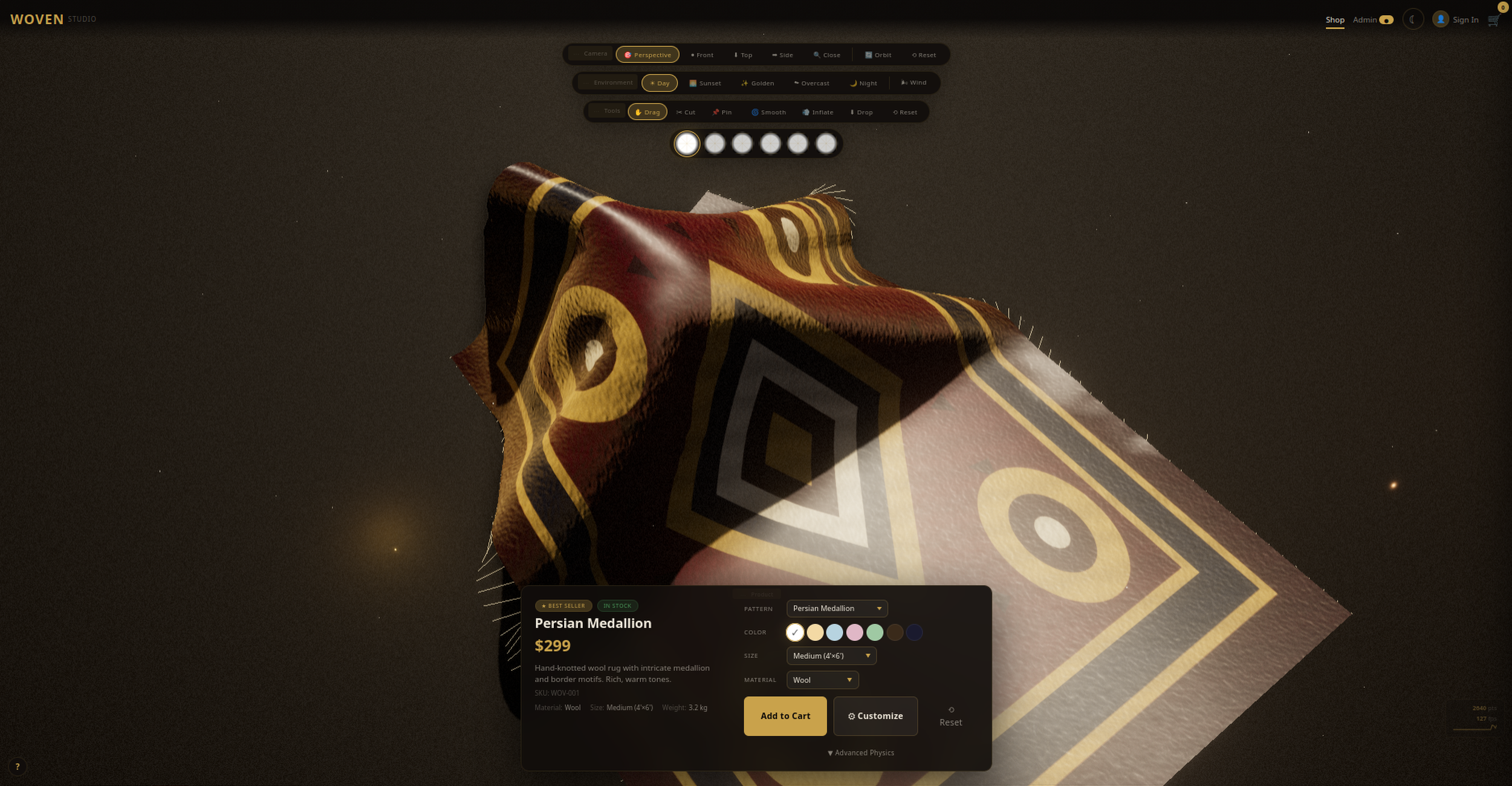
WOVEN 3D - AI-Driven Ultra-Realistic Carpet Showcase & Online Store
An AI-driven ultra-realistic 3D carpet showcase and online store demo combining physically simulated carpet behaviour, real-time PBR materials, interactive product customization and e-commerce workflows in a browser-based experience.
An AI-driven 3D insulation board showcase and engineering demo platform combining ultra-realistic PBR visualization, interactive material exploration, physics-aware simulation, thermal analysis and an integrated digital commerce environment.
3Dinteractive insulation product visualization
PBRultra-realistic material rendering
AIintelligent product and engineering assistance
Let's BuildYour AIAdvantage.
Tell us your use case. We'll identify where AI creates the most leverage — no commitment required.